MCP Server explained
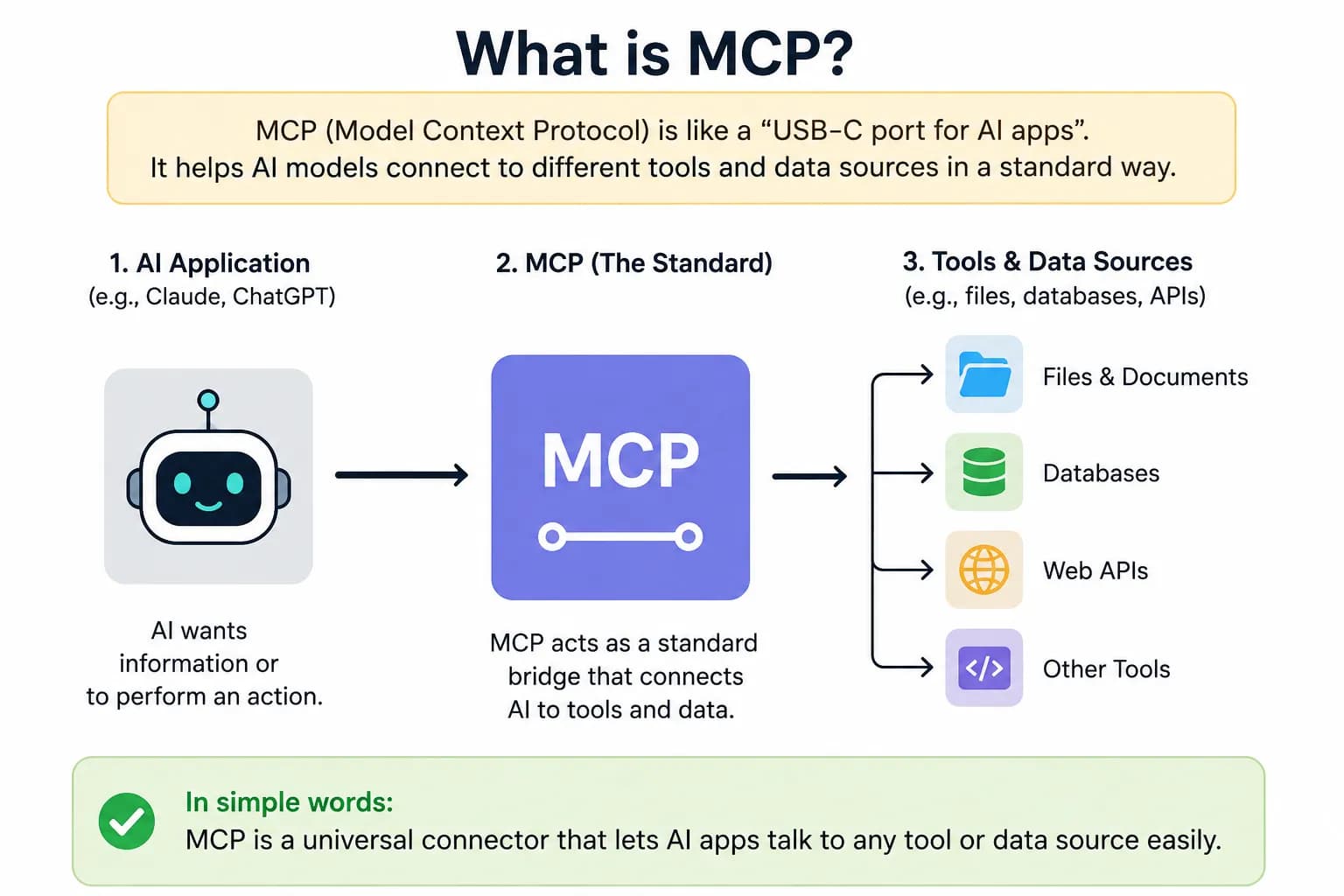
Discover how Model Context Protocol (MCP) servers standardize AI tool connectivity and eliminate the classic N×M integration challenge.

Before MCP, developer teams faced the daunting N×M integration problem: connecting N different AI models and interfaces to M distinct data repositories or SaaS tools required N × M separate custom connectors. Whenever an API updated or a new model arrived, developers had to rewrite and maintain dozens of custom integration endpoints, introducing maintenance bottlenecks and security vulnerabilities.
The Model Context Protocol flips this paradigm into an N + M model. By standardizing communication through client-server architecture, each data source only needs one MCP server implementation, and every LLM client simply connects via standard MCP client interfaces. This architecture drastically reduces engineering overhead while granting AI assistants real-time, governed context.
At Skill Oceans, understanding modern protocol layers like MCP is essential for modern software architects and AI engineers who want to build modular, enterprise-ready agentic applications.
- Key Components of the MCP Architecture:
- MCP Host: The front-end AI application or IDE (such as Claude Desktop or Cursor) initiating interactions.
- MCP Client: The internal client module maintaining a 1:1 stateful connection with dedicated servers.
- MCP Server: Lightweight program exposing specific data, resources, prompts, or actionable tools via standard JSON-RPC 2.0.
- Local & Remote Transports: Secure communication pipelines operating via stdio (for local execution) or SSE/HTTP (for remote servers).
| Traditional Custom Integrations vs. MCP Standardized Architecture: |
|---|
| • Traditional Approach: Requires N×M proprietary pipelines, brittle custom authentication wrappers, redundant tool definitions per LLM, and high ongoing maintenance costs. |
| • MCP Architecture: Requires N+M open standard connections, unified protocol security, shared prompt/tool schemas across any LLM client, and plug-and-play extensibility. |
“By standardizing context exchange, MCP turns fragmented data silos into plug-and-play knowledge bases for any intelligent agent.”
| MCP Server Primitives | Description | Typical Use Case |
|---|---|---|
| Resources | Read-only data endpoints providing structured/unstructured context | Reading log files, database tables, and API docs |
| Tools | Executable functions invokable by the LLM with user consent | Running database queries, triggering GitHub actions, API calls |
| Prompts | Pre-defined, parameterized prompt templates managed server-side | Standardized debugging prompts, code review templates |